


Boost the performance of your databases on a dedicated server
Run your databases on bare-metal servers with dedicated resources and full root access.

Consistent performance for your critical databases
Databases sit at the heart of your applications. They have to absorb queries without slowing down — and stay available at all times.
By isolating your database on a dedicated server you sidestep noisy-neighbour effects, hold performance steady and scale resources independently of your application.
Adapt the infrastructure to how you actually use it — no constraints.
High performance, controlled cost

Optimal price-to-performance
Powerful servers at a competitive price. Owning the infrastructure end-to-end means consistent performance with no hidden cost.

Predictable costs
Essentials included: unmetered bandwidth, anti-DDoS protection, IP addresses and external storage. Keep your budget under control — no surprises.

A flexible environment
Install whichever OS and database engine you choose. Configure the environment to match your technical and business constraints.

Infrastructure for every project
Host several databases or environments on the same server, or isolate them on a virtualization-and-container infrastructure for greater flexibility. Manage resources easily as your applications evolve.
Chargement du catalogue…
Infrastructure tuned for your workloads
Pick the configuration that matches your database type:
- High-performance NVMe for low-latency OLTP transactions
- Multi-core CPU for intensive analytical workloads
The private network ties nodes together for replication, clustering and high availability — so you can build an architecture that is reliable, fast and ready to scale.
Multi-environment database infrastructure
Build a secure, scalable architecture for your critical applications.
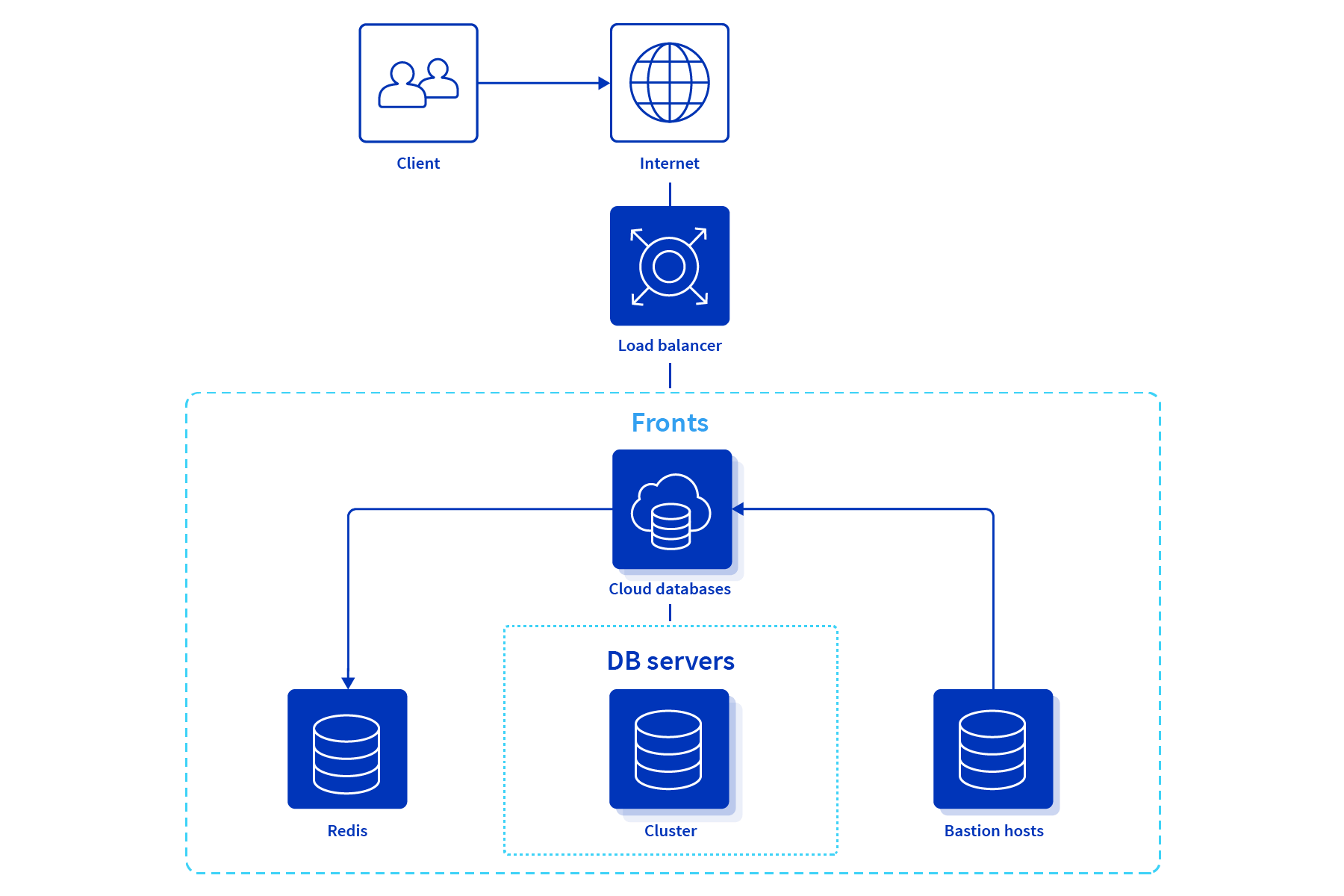
Isolate your databases on a private network, unreachable from the internet. For data subject to strict regulatory requirements, harden isolation further with a confidential-computing server that encrypts data in use.
Application servers talk to the database through this secure network, while a bastion server centralises admin access.
This architecture suits:
- e-commerce platforms
- ERPs
- SaaS applications
Add a dedicated Redis cache to speed up response times, run a replicated cluster to keep service alive when something fails, and lean on a dedicated backup-and-recovery solution to protect critical data.
Available options and services:
- Load Balancer (optional)
- unmetered traffic
- advanced memory and storage configurations
Bare metal vs DBaaS — what's the difference?
DBaaS simplifies management but limits control. With bare metal you keep full configuration access, control where data lives and benefit from fixed costs. It suits advanced needs and large volumes.
How do I migrate a database with no downtime?
Replicate the database to the new server, then switch connections progressively. The migration becomes near-transparent for end users.
Can I deploy an active-active cluster?
Yes. Spread reads and writes across nodes to remove any single point of failure. The private network keeps everything in real-time sync.
How do I monitor performance?
Use Prometheus and Grafana to track queries, disk performance and connections — quickly spotting saturation points.
Which disks should I pick for a transactional database?
NVMe disks are recommended for intensive workloads. They offer very low latency and far better performance than classic SSDs.