


Virtualize and containerize your infrastructure with full control
Roll out a private cloud or a Kubernetes cluster directly on bare-metal servers — no compromise on performance or on control of your environment.

Your challenges
Running virtualised or containerised infrastructure surfaces several challenges fast:
- keeping costs in check against variable cloud pricing
- avoiding constraints imposed by certain platforms
- guaranteeing consistent performance
- ensuring data sovereignty and locality
You need a reliable, flexible, predictable foundation to grow your projects on.
High performance, controlled cost

A durable performance/price balance
Powerful servers at a competitive price — no compromise.

Clear, predictable costs
Essentials are included from day one: unmetered bandwidth, anti-DDoS, IPv4 and IPv6 addresses, external storage and technical support.

Wide choice of OS and software
Install the right environment fast: Debian, Ubuntu, Windows Server, Rocky Linux…

Infrastructure built to evolve
A single server can host multiple applications, websites or customer environments.
Chargement du catalogue…
The answer: bare metal, no compromise
With Kimsufi bare-metal servers you build infrastructure on your own terms.
Pick freely:
- your hypervisor (Proxmox, VMware ESXi, KVM, Hyper-V)
- your orchestration solution (Kubernetes, Docker Swarm, Apache Mesos)
- your network configuration
Your data stays hosted in Europe, on infrastructure not subject to the CLOUD Act.
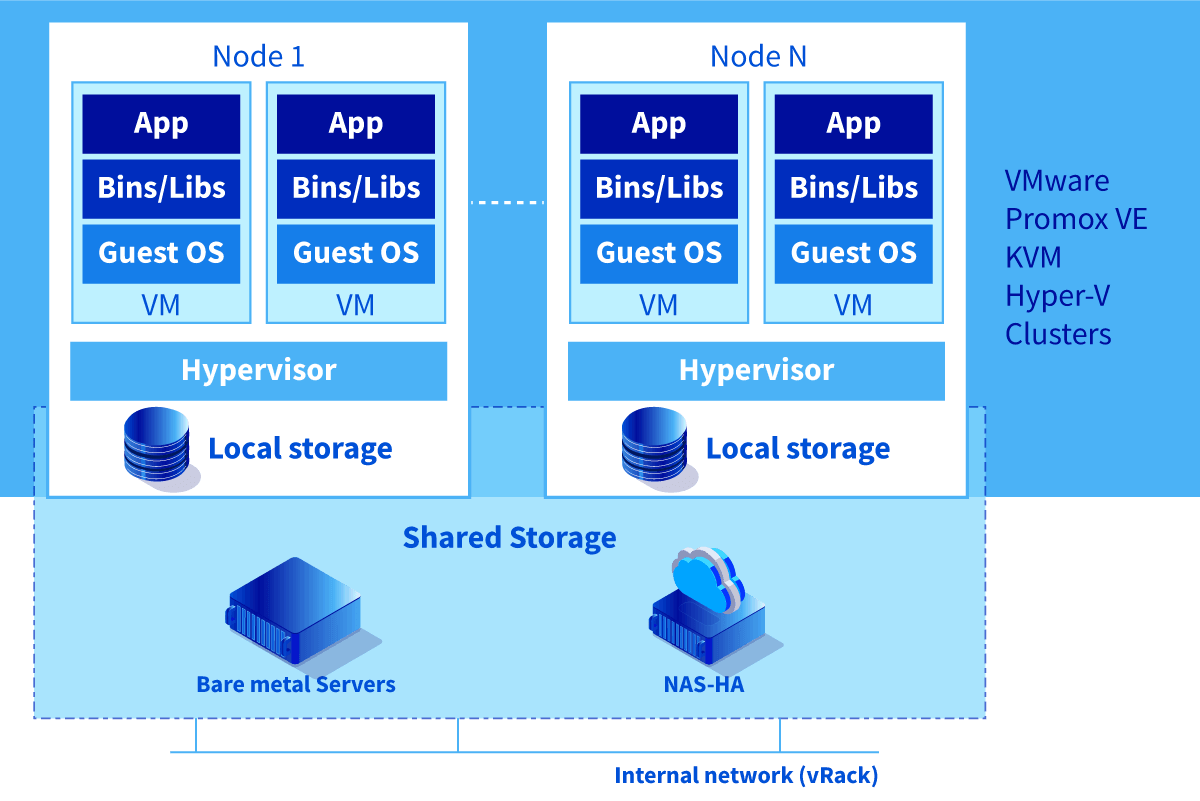
Virtualisation: consolidate and optimise resources
Consolidate underutilised servers onto a single virtualised infrastructure.
Benefits:
- better resource utilisation
- service continuity
- simpler infrastructure
How many VMs can I deploy?
It depends on the server resources and how you size each VM. A powerful server can host dozens if resources are tuned.
Bare-metal Kubernetes vs managed — which to pick?
Managed Kubernetes simplifies operations but adds constraints and variable costs. Bare metal lets you keep version control, network freedom and fixed costs.
How do I migrate from VMware?
Export your VMs (OVF/OVA) then import them on the new infrastructure. Tools like virt-v2v automate the migration.
How do I ensure high availability?
For a Kubernetes cluster: use at least 3 master nodes, set up a load balancer and lean on distributed storage.
Which orchestrator should I pick?
Kubernetes for complex architectures, Docker Swarm for a simpler setup, Apache Mesos for hybrid environments.